Call (561) 309-9603 Get My Risk Score

Every Season You Wait Makes the Problem Worse and the Fix More Expensive

South Florida shoreline erosion is not a cosmetic issue. It is a compounding liability with real financial consequences for HOA boards, property managers, and communities that let it go unaddressed.

The Cost of Waiting

Erosion Does Not Pause While You Wait for Board Approval

South Florida's wet season runs May through October. Every season an eroding bank goes unaddressed, the damage multiplies. The repair that costs one dollar today costs three to five dollars in two years. That is not a metaphor. That is what we see on every late stage project we assess.

Year 1
Bare bank edge, soil loss beginning

Shallow erosion strip at the waterline. Grass is receding. The bank looks thin but still intact. This is the cheapest and easiest stage to fix. Containment plus vegetation handles it cleanly.

Year 2 to 3
Active undercutting underway

The bank face begins to slump. Roots are exposed. Erosion extends below the waterline. Repair scope grows by 2 to 3 times. Each wet season doubles the damage from the season before.

Year 4 and Beyond
Structural failure, full liability exposure

The bank collapses onto adjacent property or infrastructure. The HOA faces legal claims. Repair now requires full bank reconstruction. You are no longer fixing erosion. You are rebuilding a bank.

The Real Cost of Erosion

What an Unaddressed Bank Actually Costs Your Community

Most HOA boards think about erosion as a landscaping problem. It is not. It is a property, liability, and compliance problem that compounds every quarter you delay.

Adjacent Property Loss

When a common area bank fails it does not stop at the property line. Soil migrates onto homeowner lots, undermines fencing, destroys landscaping, and in severe cases destabilizes the ground beneath structures. The association owns the bank. The association owns the outcome.

HOA liability follows the deed

Personal Injury Liability

A mower goes over an undercut bank edge. A maintenance worker steps into a collapsed section. A child playing near the lake falls into a void where the bank used to be. These are not hypotheticals. They happen every wet season across South Florida communities with deferred shoreline maintenance. The HOA board is named in the suit.

Incidents that were preventable

Equipment and Infrastructure Loss

Lawn maintenance equipment, irrigation infrastructure, and utility lines run along shoreline edges throughout HOA communities. When a bank fails it takes whatever is above it. A zero turn mower into a retention pond is a workers compensation claim, a replacement equipment cost, and a hazmat situation. Soft bank edges look solid until they are not.

Banks fail without warning

Regulatory and Compliance Exposure

An HOA that allows a retention pond bank to fail to the point of sediment discharge can face FDEP notices of violation. South Florida Water Management District enforcement actions carry fines that dwarf the cost of the repair that would have prevented them. Compliance is not optional and it is not deferred.

FDEP violations compound fast
Active erosion at HOA retention pond South Florida

Active erosion at HOA retention pond, South Florida. The bank is already undercut below the waterline by two to three times what is visible from the surface.

Now
Visible erosion strip

Manageable with containment and revegetation. Subsurface failure already 2 to 3 times wider than what you can see.

After 1 wet season
Bank slumping and undercutting

Repair now requires bank reconstruction before containment can be installed. Scope doubles. The window for a lower cost fix has closed.

After 2 seasons
Structural failure and liability

Bank collapse possible in a single storm event. Fencing, equipment, and adjacent property now at risk. The board is on record having known about it.

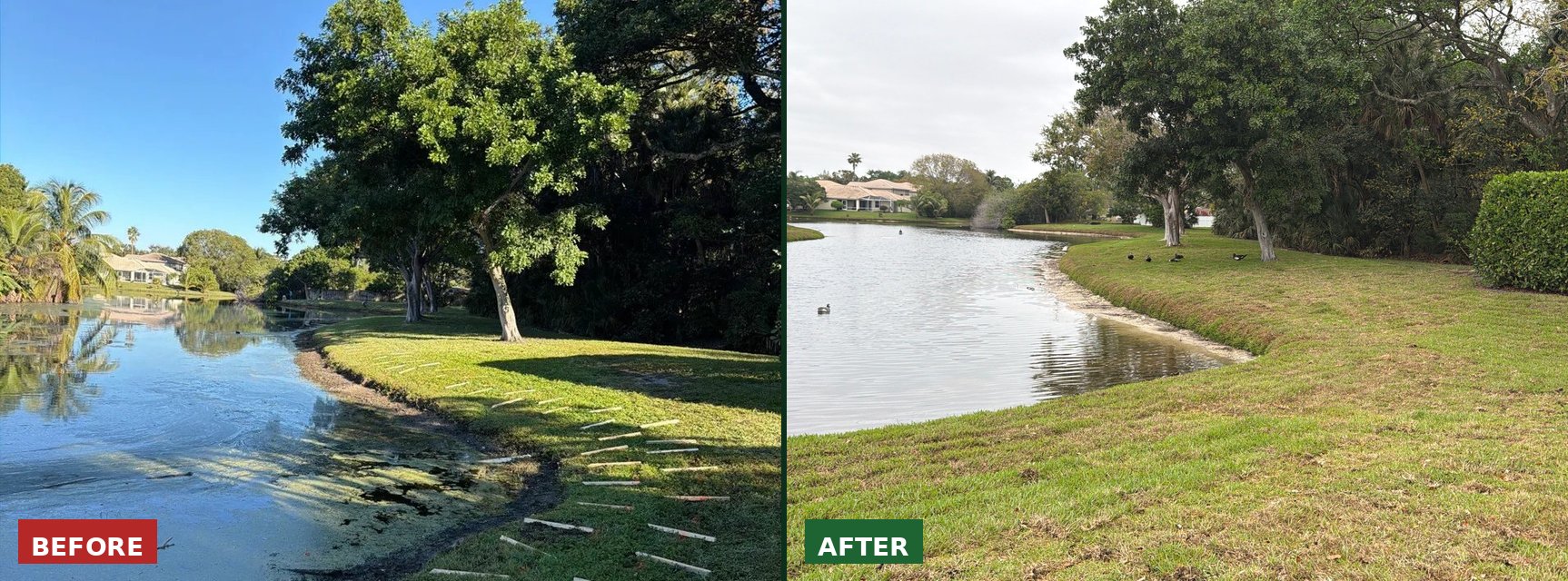
Stabilized bank after Green Image installation

Same bank after stabilization. Containment installed, bank profile restored, liability eliminated.
The Right Solution

Why It Has to Be a Living Shoreline

There is more than one way to stop a bank from eroding. Most of them only work for a few years. A living shoreline combines physical containment with native vegetation and becomes more resilient over time, not less. It is also the approach Florida regulators explicitly favor over hard armoring on freshwater systems.

Hard armoring — riprap and seawalls
  • Transfers erosion load to adjacent unprotected sections
  • Eliminates natural habitat and water filtration function
  • Requires ongoing maintenance and eventual full replacement
  • Prohibited or restricted on many Florida freshwater bodies
  • Becomes less effective as it degrades and does not self-repair
  • Higher 10 year total cost than a living shoreline approach
Living shoreline — our approach
  • Biodegradable containment holds the bank while roots establish
  • Native vegetation becomes stronger every single growing season
  • Improves water quality through natural filtration of runoff
  • Fully compliant with FDEP and SFWMD regulations
  • Self-sustaining after establishment with lower long term cost
  • Increases property values and community aesthetics
What You Actually Get

The Benefits of a Living Shoreline

A properly installed living shoreline does more than stop erosion. It creates a self-sustaining system that improves the value and function of your water body with every passing season.

Permanent Bank Stability

Native root systems develop dense underground structure that physically anchors the bank. After two growing seasons the root mass is stronger than any installed containment system. The fix gets better over time.

Water Quality Improvement

Littoral zone plantings filter stormwater runoff before it reaches the open water body. This reduces nutrient loading, algae blooms, and the maintenance burden on your lake management vendor.

Habitat Restoration

Native shoreline vegetation provides nesting and foraging habitat for birds, turtles, and fish. HOA communities consistently report improved aesthetics and resident satisfaction after installation.

Regulatory Compliance

Florida increasingly restricts hard armoring on freshwater systems. Living shoreline approaches are explicitly favored by FDEP and South Florida Water Management District. Getting ahead of this now avoids future enforcement actions.

Lower Long Term Cost

Hard armoring requires inspection, maintenance, and eventual replacement. A living shoreline once established is self-maintaining. The 10 year cost of a living shoreline is consistently lower than equivalent hard armoring on the same bank.

Increased Property Value

Stabilized, vegetated shorelines increase the perceived value of lakefront lots and community amenities. A well-maintained lake bank is a direct asset to every property value in an HOA community.

Real South Florida Results

What It Looks Like in Practice

Two complete HOA lake bank stabilization projects from eroded bank to finished installation.

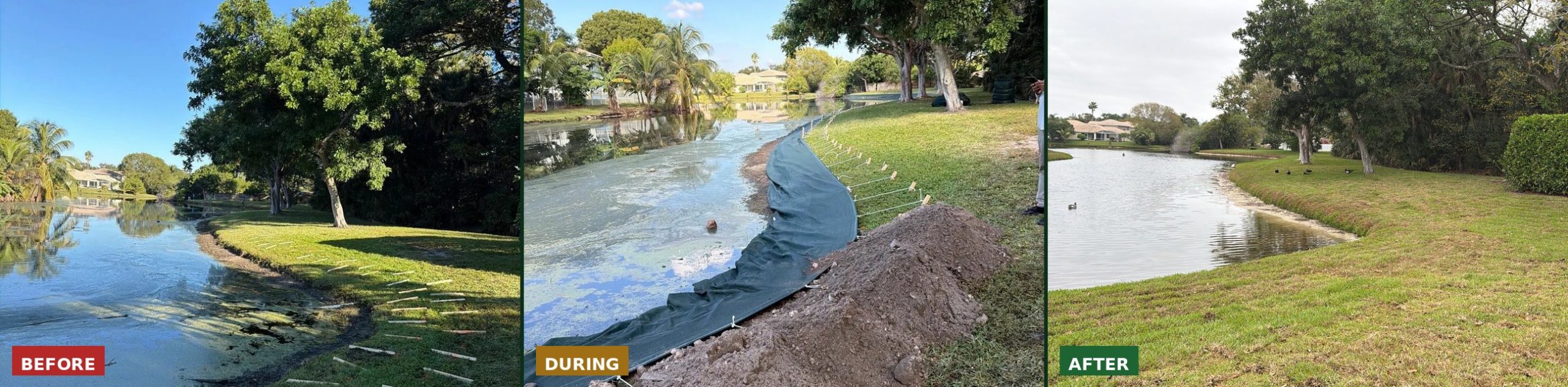
HOA lake bank stabilization before during and after South Florida

Job A — HOA Lake Bank, South Florida. Before, during installation, and completed stabilized bank.

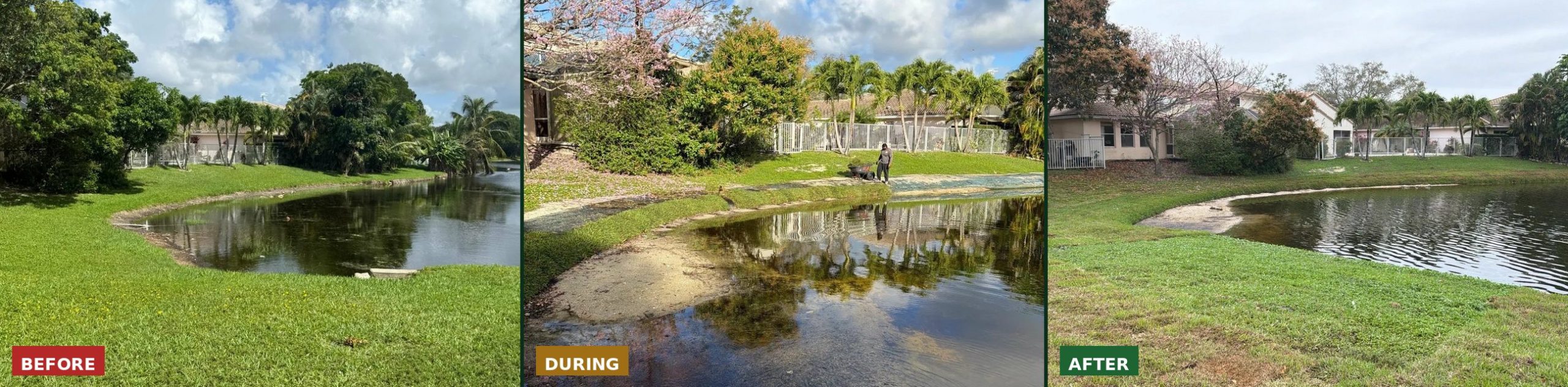
HOA retention pond erosion repair before during and after

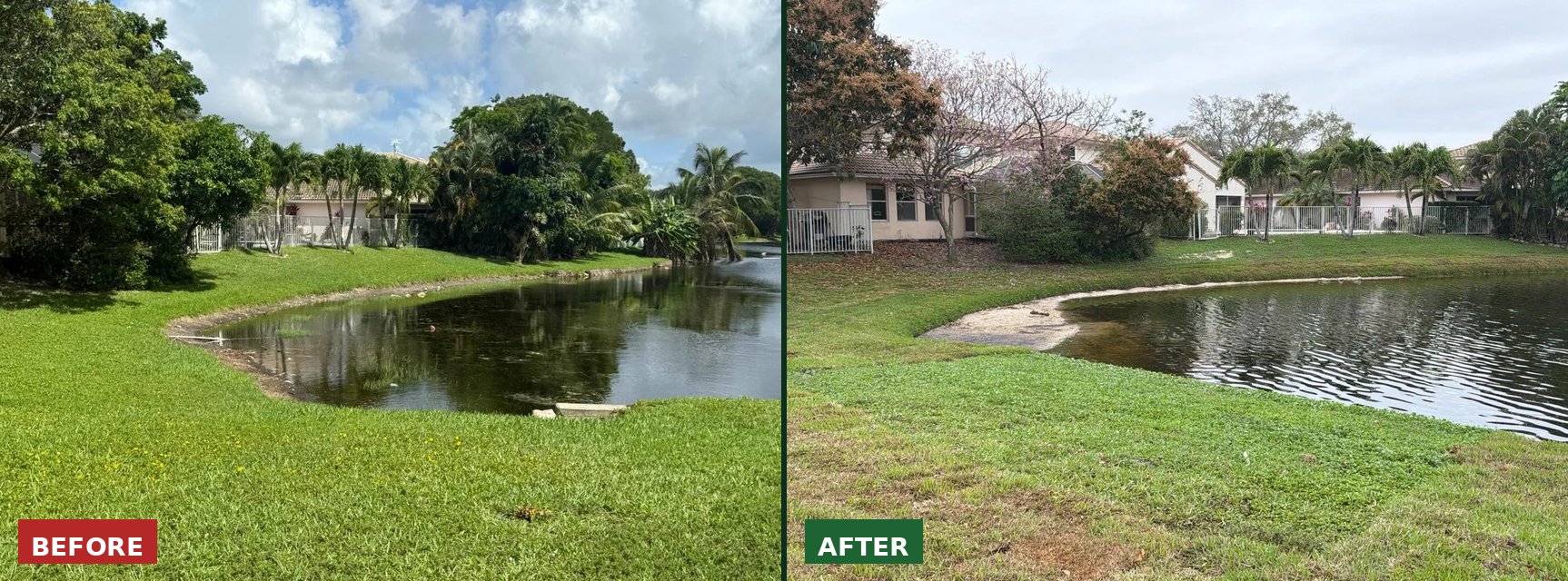
Job B — HOA Retention Pond, South Florida. Active erosion, crew on site, stabilized shoreline.

Job A before and after

Job A — Before and After.

Job B before and after

Job B — Before and After.

Why South Florida Is Different

The Numbers That Make This Region Unusually Vulnerable

60"
Average annual rainfall across South Florida
6 mo.
Active wet season accelerating bank loss every year
3 to 5x
Cost multiplier from year 1 to year 4 repair
75,000+
Stormwater ponds in Florida — South Florida holds the largest concentration

South Florida's combination of sandy soils, high water tables, and intense seasonal rainfall creates conditions that accelerate bank erosion faster than almost anywhere else in the continental United States. The same problem that takes 10 years to become serious in the Carolinas takes 2 to 3 years here. Your bank is not on a national timeline. It is on a South Florida timeline.

Why Green Image Shoreline

We Do Not Just Install. We Commit.

Every project we take on is governed by four values that run through every conversation, every site visit, and every installation. They are not marketing language. They are the operating standard we hold ourselves to on every job and the reason our clients trust us with their most visible community assets.

C
Communication

You know what is happening on your project at every stage. Assessment findings are documented and written in plain language your board can act on. We do not disappear between site visit and installation day. Property managers know the timeline, the scope, and the crew before work begins.

A
Accountability

The people who assess your site are the people who install the work. We follow up after the first rainy season on every project. If something is not performing as expected, we come back. No negotiation. No invoice. A project is not done when we leave the site. It is done when the bank holds.

S
Safety

We work in active HOA communities around residents, children, and maintenance staff. Our crew follows site safety protocols on every job without exception. We also assess and document the safety risk of an unaddressed eroding bank so your board understands the liability exposure they are managing.

A
Appearance

We leave every site cleaner than we found it. Our installations are designed to look finished from day one and to improve visually as vegetation establishes. A stabilized bank is a community asset. We treat it like one.

What Sets Our Work Apart

Six capabilities that no other crew in South Florida brings to your project.

Our Fill Is Custom to Your Water Body

Every water body in South Florida has different soil composition, water chemistry, organic content, and biological activity. Off the shelf fill materials ignore all of that. We formulate and source fill specifically matched to the conditions at your site. What goes into the containment system on your lake bank is engineered for your water body. That specificity is what makes the difference between a system that holds for two years and one that holds for twenty.

A Proprietary Fill System That Gets Us In and Out Faster Than Anyone Else

We designed and built our own filling system. It is not available to other contractors. It allows us to deploy containment at a pace and precision that no other crew in South Florida can match. Faster installation means less disruption to your community, tighter project timelines, and lower mobilization costs. When a property manager needs a job done without a two week presence on the bank, this is how we deliver that.

We Assess First. Every Time. No Exceptions.

We do not quote over the phone. We do not prescribe a solution before we have seen the site. Every project starts with a free on-site walk where we evaluate soil conditions, water depth, bank geometry, and the actual source of the erosion. What we find determines what we recommend. This is how projects succeed the first time. It is also the reason every property manager we have ever worked with has sent us to another community.

Local Crew. Not Subcontractors.

Every project is installed by our crew, based in South Florida. We do not hand off to subcontractors, dispatch from a regional office two states away, or send whoever is available. The people who assess your site are the people who install the work. That accountability runs through every project we take on and it is why property managers come back to us instead of shopping the job out every time.

We Have Been Here for 15 Years

Green Image has operated commercial environmental and landscaping services across South Florida since 2010. We have been on these properties, inside these communities, and managing these water bodies for over a decade. We know the soil profiles. We know the water body behaviors. We know what a South Florida wet season does to a bank that was not built to handle it.

We Follow Up After the Rainy Season

We inspect every project after the first significant storm season. If something is not performing as expected, we come back. No negotiation, no invoice. That follow-up is part of how we define a completed job. A project is not done when we leave the site. It is done when the bank holds through its first wet season. We have built a 15 year business on that standard.

What you get when you work with us

1

A bank that holds. Full stop.

Stabilized, documented, and inspected after the first storm season. Not just installed and invoiced.

2

Documentation your board can act on immediately

Written assessment, photo documentation, and a scope your board can read, vote on, and file for insurance purposes.

3

A community asset that improves over time

A living shoreline gets stronger every growing season. Two years after installation your bank is more stable than it was on day one.

4

Liability eliminated, not deferred

A stabilized bank removes the injury risk, the property damage exposure, and the FDEP compliance vulnerability in one project.

15+
Years serving South Florida commercial properties
Operating since 2010
100%
Projects successfully completed
On scope. On time. Every one.
Zero
Banks that have failed after a Green Image installation
We follow up after every rainy season to make sure it stays that way.
Get Ahead of It

Free Shoreline Assessment. No Commitment.

We come to the site, walk the bank, and tell you exactly what stage of erosion you are dealing with and what it will take to fix it before it gets worse. No charge. No pressure. Just a straight answer so your board can make an informed decision.

(561) 309-9603 Mon through Sat, 7am to 6pm